+Vic Gundotra and team at Google for making it possible to link to +Google+ profiles. Now I can advertise myself +Vijay Patil in my blog posts :-)
21 January, 2013


Reuse existing railways tracks for Pune Metro
DMRC Report (2009) on Pune Metro
According to latest news article Centre okays metro, asks Pune Municipal Corporation to plan mono rail, Pune metro route will be based on DMRC report (2009).Official documents related to Pune Metro including DMRC report (July 2009) on the PMC website for Pune citizens (and elected representatives) to study, understand, think carefully.
I spent some time studying first 3 chapters of the document, with
expectation to find clear description of :
- What is current traffic/transportation situation in Pune region?
- Why metro is needed for Pune region?
- How best routes for the metro are identified?
- How metro is guaranteed to solve traffic problems and how to
measure the progress/improvements in quality of life? - I also expected that PMC would append it's own report to the DMRC report, about how other modes of transportation (PMPML, BRT, Cycle tracks, 2 wheeler Parking etc. etc) will be integrated with proposed Pune Metro. What are targets/objectives/goals to be achieved before finalizing Pune metro.
In this blog post, one specific aspect about proposed Pune Metro project is discussed.
Reuse of existing railway tracks
How we can improve public transportation capacity and quality, with
maximum probability of success and minimal investment? What if Pune
metro is created reusing existing railways tracks.
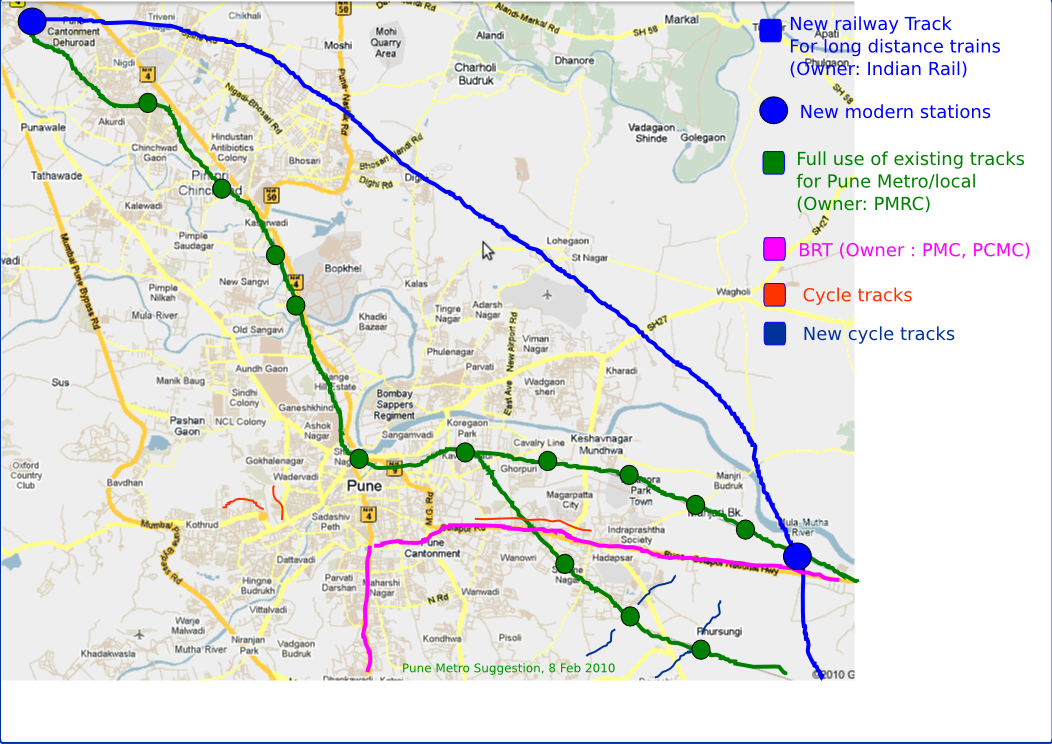 |
| Re-using existing tracks for Pune Metro |
Note: BRT and cycle tracks shown in above figure are approximate just to illustrate the integration with other project.
Note: PMRC stands of Pune Metro Rail Corporation (just for example)
As shown in the above figure:
As shown in the above figure:
+ Concept involves taking over Indian railways tracks in central areas of Pune region and converting them into Pune metro (above ground local trains). Full capacity will be used. If needed additional capacity could be added (TODO: How?).
+ What happens to long distance trains of IR? Indian railways is requested to create a new track on the out skirts of the city. New railways stations will be constructed, one for Pimpri chinchwad and other for Pune. New modern Railway Stations will be connected to city by Pune metro and BRT.
+ What happens to long distance connectivity? Western part of Pune region is already well connected to other regions due to NH4. New track by IR will connect eastern part of Pune. This is good balance.
Note : I do not have any degrees in Urban planning or transportation. This
is a suggestion that needs more thought and official response/explanation.
If I get time, I would like to discuss this idea with officials and like to hear the counter argument. Feel free to print this post and discuss with relevant people.
09 December, 2012
Interview with Tobias at FOSS.in 2012
At FOSS.in 2012, Bengaluru, I interviewed Tobias (of GNOME) and Muthu. Hope you find some useful information.
Interview with Tobias
Background
Tobias gave talks on "Triaging Bug Reports in GNOME" and GNOME 3.6 talk.
First part of interview I tried to find out Tobias's role/relationship with GNOME. I was under impression that since he is core member of GNOME Bugsquad team, he would be a full time employee at GNOME. I was curious to know how many such full times employees work for GNOME and how GNOME financially supports them.
Second part of interview focuses on bug reports and contributing to GNOME development.
Part I: Business/Financial Model
Q. Vijay: Who uses GNOME? (Background: GNOME consists of many interesting projects that could be used for variety of purposes)
A. Tobias: Linux distributions use GNOME projects (as packages), but not all projects are used by the distributions. A particular distribution (like Ubuntu) may have their own replacement project for a GNOME project.
For gnomy distribution would be Fedora.
Q. Vijay: How does GNOME earn money, specifically how does it pay salaries of full times employees like you?
A. Tobias: I am not a full time employee of GNOME, I am a student. GNOME has may be couple of few time staff and does not have a significant revenue stream. Most of people (bug squad team, project developers/maintainers etc.) are employed by companies like RedHat etc.
Q. Vijay: In India although people (students, software developers working at various IT companies) are enthusiastic about contributing to a free software project, they soon give up, as their day jobs sucks out all the time (thanks notorious traffic) and energy. So wouldn't it be nice if someone pays them to work on free software project and to attend conferences like FOSS.in?
A. Tobias: Yes, they would work at Linux friendly companies like Redhat. They have office in Pune.
Q. Vijay: What if someone sets a small company or forms a group of engineers fresh out of colleges who might not easily get a jobs this year (see news) and guide them to work on free software projects? Would that work?
A. Tobias: How much would it cost to hire such engineer, fresh out of college?
A. Vijay: At least Rs. 20,000 a month i.e. 300 Euros a month for work that involve simple bug triaging etc. (not software developers).
A. Tobias: Who will pay for this salary?
A. Vijay: Initially someone who has some spare money and is passionate about free software and has benefited from it could sponsor such initiative. Of course, later a revenue stream should be identified to continue support the work. Individual contributors (however small in number) in India would continue to contribute, but with this approach we remove some obstacles that prevent young engineers to contribute to free software projects. Since they work as a group (preferably in same office), knowledge sharing etc. would be quick and effective.
Part II: Contributing to GNOME
Second part of interview we discussed how anyone interested in GNOME technology and applications could become individual contributor and help this free software project go forward maintaining good quality.
Q. Vijay: You mentioned that there are about 25 thousand bugs (with status = UNCONFIRMED) on the GNOME bugs database. You also mentioned that bug reports on only latest 2 GNOME releases are accepted (any release before it is not supported), so my question is should we try to see if those old bug reports are still re-producible on latest 2 GNOME releases. Many of them would not be and that way we could close them.
A. Tobias: Yes this is a good idea. Scenarios for old bug reports should be carried out on new GNOME releases and if they are OK, bug reports could be closed as OBSOLETE, reducing no. of counts of old bug reports. Otherwise they should be opened as NEW on the latest release.
Q. Vijay: You said no. of new bugs reported per week in GNOME bugzilla is going down (current no. is 500). That is because some users now report a bug in distribution's bugzilla (like https://launchpad.net/ubuntu). How does co-ordination work?
A. Tobias: This is bit challenging to manage. Someone looking at distribution's bugzilla has to do a search in GNOME bugzilla and check if the issue is already reported there, and if yes put a link to the bug report. Then check again if it is fixed and then change the status of in the distribution's bugzilla. As you can see, this involves lots of work and needs a better idea.
Q. Vijay: For bug reports we maintain a fun statistics about 'Top Opener' and 'Top closer' based on no. of bug reports opened or closed by a person. How come there are some common names in the list that you showed. Does developer closes a bug report after he applied a patch to fix it?
A. Tobias: Usually developers just fix the bug with some patch and but they do not close the bug report. Bug is usually closed by person who originally changed its status from UNCONFIRMED to NEW gets to close the bug report and chance to become 'Top Closer'.
Q. Vijay: When does a project become part of GNOME? Is Inkscape part of GNOME? How about LibreOffice?
A. Tobias: Inkscape uses GNOME projects like libxml and hence a GNOME application. What does it even mean for a project to be part of GNOME? It is bit a gray area. But usually it becomes gradually clear if a project should be part of GNOME.
Rest of the interview, we talked about how having a good IDE is important for attracting new applications in GNOME and Linux distributions.
Interview with Muthu
Muthu has been hacking on LibreOffice and told me lots of interesting stuff. Stay tuned to this blog ...
Interview with Tobias
Background
Tobias gave talks on "Triaging Bug Reports in GNOME" and GNOME 3.6 talk.
 |
| GNOME Bug Triaging Talk by Tobias |
First part of interview I tried to find out Tobias's role/relationship with GNOME. I was under impression that since he is core member of GNOME Bugsquad team, he would be a full time employee at GNOME. I was curious to know how many such full times employees work for GNOME and how GNOME financially supports them.
Second part of interview focuses on bug reports and contributing to GNOME development.
Part I: Business/Financial Model
Q. Vijay: Who uses GNOME? (Background: GNOME consists of many interesting projects that could be used for variety of purposes)
A. Tobias: Linux distributions use GNOME projects (as packages), but not all projects are used by the distributions. A particular distribution (like Ubuntu) may have their own replacement project for a GNOME project.
For gnomy distribution would be Fedora.
Q. Vijay: How does GNOME earn money, specifically how does it pay salaries of full times employees like you?
A. Tobias: I am not a full time employee of GNOME, I am a student. GNOME has may be couple of few time staff and does not have a significant revenue stream. Most of people (bug squad team, project developers/maintainers etc.) are employed by companies like RedHat etc.
Q. Vijay: In India although people (students, software developers working at various IT companies) are enthusiastic about contributing to a free software project, they soon give up, as their day jobs sucks out all the time (thanks notorious traffic) and energy. So wouldn't it be nice if someone pays them to work on free software project and to attend conferences like FOSS.in?
A. Tobias: Yes, they would work at Linux friendly companies like Redhat. They have office in Pune.
Q. Vijay: What if someone sets a small company or forms a group of engineers fresh out of colleges who might not easily get a jobs this year (see news) and guide them to work on free software projects? Would that work?
A. Tobias: How much would it cost to hire such engineer, fresh out of college?
A. Vijay: At least Rs. 20,000 a month i.e. 300 Euros a month for work that involve simple bug triaging etc. (not software developers).
A. Tobias: Who will pay for this salary?
A. Vijay: Initially someone who has some spare money and is passionate about free software and has benefited from it could sponsor such initiative. Of course, later a revenue stream should be identified to continue support the work. Individual contributors (however small in number) in India would continue to contribute, but with this approach we remove some obstacles that prevent young engineers to contribute to free software projects. Since they work as a group (preferably in same office), knowledge sharing etc. would be quick and effective.
Part II: Contributing to GNOME
Second part of interview we discussed how anyone interested in GNOME technology and applications could become individual contributor and help this free software project go forward maintaining good quality.
Q. Vijay: You mentioned that there are about 25 thousand bugs (with status = UNCONFIRMED) on the GNOME bugs database. You also mentioned that bug reports on only latest 2 GNOME releases are accepted (any release before it is not supported), so my question is should we try to see if those old bug reports are still re-producible on latest 2 GNOME releases. Many of them would not be and that way we could close them.
A. Tobias: Yes this is a good idea. Scenarios for old bug reports should be carried out on new GNOME releases and if they are OK, bug reports could be closed as OBSOLETE, reducing no. of counts of old bug reports. Otherwise they should be opened as NEW on the latest release.
Q. Vijay: You said no. of new bugs reported per week in GNOME bugzilla is going down (current no. is 500). That is because some users now report a bug in distribution's bugzilla (like https://launchpad.net/ubuntu). How does co-ordination work?
A. Tobias: This is bit challenging to manage. Someone looking at distribution's bugzilla has to do a search in GNOME bugzilla and check if the issue is already reported there, and if yes put a link to the bug report. Then check again if it is fixed and then change the status of in the distribution's bugzilla. As you can see, this involves lots of work and needs a better idea.
Q. Vijay: For bug reports we maintain a fun statistics about 'Top Opener' and 'Top closer' based on no. of bug reports opened or closed by a person. How come there are some common names in the list that you showed. Does developer closes a bug report after he applied a patch to fix it?
A. Tobias: Usually developers just fix the bug with some patch and but they do not close the bug report. Bug is usually closed by person who originally changed its status from UNCONFIRMED to NEW gets to close the bug report and chance to become 'Top Closer'.
Q. Vijay: When does a project become part of GNOME? Is Inkscape part of GNOME? How about LibreOffice?
A. Tobias: Inkscape uses GNOME projects like libxml and hence a GNOME application. What does it even mean for a project to be part of GNOME? It is bit a gray area. But usually it becomes gradually clear if a project should be part of GNOME.
Rest of the interview, we talked about how having a good IDE is important for attracting new applications in GNOME and Linux distributions.
Interview with Muthu
Muthu has been hacking on LibreOffice and told me lots of interesting stuff. Stay tuned to this blog ...
Subscribe to:
Posts (Atom)